Everything You Need to Know: Difference Between Recycled and Recyclable
Check out the distinction between recycled and recyclable materials. Learn their definitions, what they are, and what you stand to gain from that knowledge.

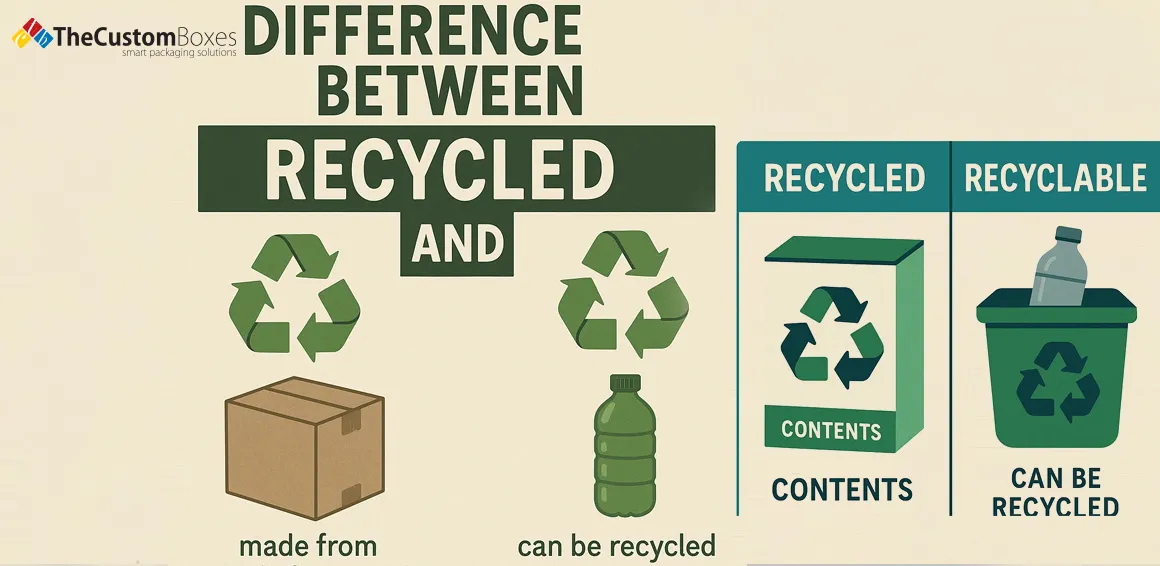
Have you ever walked through the market and noticed the packaging around you? Each product displays a symbol. Leaves, arrows, and nature-inspired images. "Eco-friendly!" "Recycled!" "Recyclable!" When these words appear on packaging, consumers often assume they all mean the same thing.
Yet they actually pertain to two phases of sustainability. They stand for concepts. Yet companies utilize them as they please. We generally just go along with it because, honestly, who has the time to master packaging labels? The point is, this goes beyond an irritation. The misunderstanding is genuinely leading to harm to the environment.
If you operate a business and are selecting packaging for your products, grasping this distinction is really important. Opt for materials that the majority of recycling centers cannot handle and still market them as eco-friendly?
That’s not deceiving customers; you’re also inviting a reputation issue when buyers finally realize the truth. Nowadays, they are realizing it more quickly because information travels fast. In this article, we will present the difference between recyclable and recycled.
What Does Recycled Mean?
Recycled materials come from stuff people threw away that got intercepted before hitting a landfill. It had a whole life before this. Someone used it, tossed it out, it got collected, broken down, and now here it is again as a new product.
From a perspective, recycled denotes any substance that has been previously utilized. Subsequently, it is collected, treated, and converted into a product. Thus, when you handle packaging made from material, you are holding an item that has completed its full life span and received a second opportunity.
Waste items that have been reverted to materials serve as the foundation for producing recycled materials. Producers utilize what has already been thrown away to obtain fresh resources from the planet. It is similar to turning yesterday's garbage into a product for today.
Consider it this way: recycled is in the past tense. It has already taken place. What you are holding was once something else.
How recycled materials are created (collection → processing → remanufacturing)
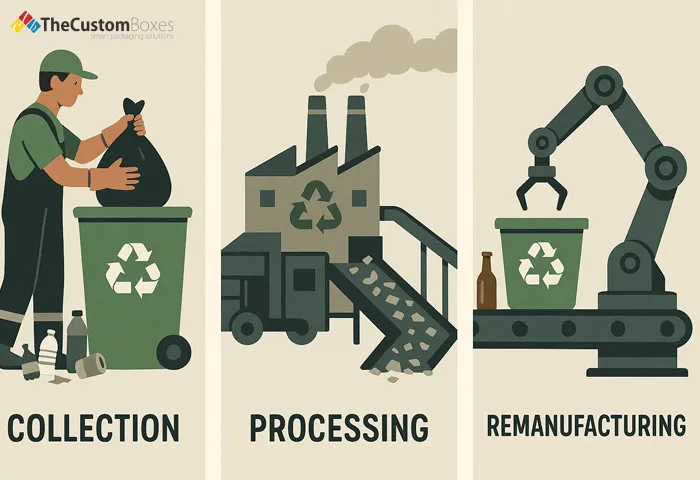
The journey of recycled materials usually follows this path:
-
Collection
Goes out that you put in your blue bin or at the rec center. Trains come by, and they collect it all into sorting facilities. Not the flashiest part of the process.
-
Sorting
We have workers and machines that separate everything by type because you can’t mix materials.
-
Cleaning and Processing
Then it is all cleaned out, labels are taken off, we wash off the debris, and break down the materials. Paper becomes wet pulp. Metal is compressed. We are trying to get back to a usable state for manufacturers.
-
Remanufacturing
Pulp becomes boxes. Plastic is melted into new bottles or containers. Aluminum is formed into cans. It takes weeks, sometimes months. Also, not all make it through. Contamination is an issue. Sorting misses some.
This whole cycle plays a role in the reduction of the extraction of raw materials like trees, oil, and minerals.
Examples of common recycled materials
Look around you right now. You will see products made from recycled content in things like:
- Recycled cardboard shipping boxes
- Recycled paperboard packaging
- Recycled corrugated boxes
- Kraft boxes made from recycled fibers
- PCR plastic bottles
- Recycled glass jars
Benefits of using recycled content
The benefits of using recycled content are many. The following are some reasons why:
Resource Reduction
Trees stand. Oil stays in the ground. Ores in the mountains. Very simple math, really. Ecosystems that are left intact. Resources for future generations.
Energy Savings
This is where it becomes truly remarkable. Employing recycled materials in production consumes less energy compared to creating from raw materials. We cut costs. Support environmental preservation.
What Does Recyclable Mean?
What we mean by recyclable is a substance which is able to be recycled. It is a material that may be used again. It is in its natural state. It has not been used before. Also, it does not have a past life. Thus, a recyclable material is one that may be put through the cycle of use again after its first use. Think of “recyclable” as a material for the future.
Examples of recyclable items
.webp)
Below are some of the recyclable items:
-
Paperboard
Paperboard is used for beauty product boxes and retail packaging. Also, cereal boxes fall in this category.
-
Glass
Jars and bottles of glass are the most common items put in the recycle bin, and also the only type that you can recycle over and over again without the quality going down.
-
Metals
Aluminum and steel cans are very easy and efficient to recycle. They make up a large part of recycled metals.
-
Plastics
Not all plastics are recyclable. Only PET (#1) and HDPE (#2) are recyclable.
Challenges In Recycling
A material can be recycled. But it is not guaranteed. The following are some of the challenges in recycling:
-
Contamination
A food-stained cardboard box or one that still has liquid in the bottle won’t be accepted.
-
Lack of facilities
Also, some cities do not have the proper equipment to process all types of materials - especially lower-grade plastics.
-
Mixed materials
Those products made with layers of plastic and foil are almost out of the question for recycling, as machines can not separate the materials.
Key Differences Between Recycled and Recyclable
To understand the key difference between recycled and recyclable, understand the following:
Material Origin
- Recycled materials are produced from used materials.
- Recyclable materials are fresh. They come from plants, etc.
Environmental Impact Differences
- The use of recycled materials reduces the demand for resource extraction.
- Whereas the materials that can be recycled reduce landfill waste
- They both are healthy for the environment.
- Green users demand both.
Why Understanding the Difference Matters
Clients are swift to highlight greenwashing, which can be prevented by applying these terms.
Importance of brands using eco-friendly packaging
Consumers anticipate that a company's packaging will truly be "green" when it asserts this. Establishing trust is aided by the implementation of recyclable or recycled packaging.
Environmental responsibility and waste reduction
When businesses undertake material selection, they might:
- Decrease total emissions output
- Minimize the waste sent to landfills
- Supports the circular economy
- Stay in compliance with industry standards
- It is a win for both the business and the environment
Types of Recycled Materials
The following are some of the types of recycled materials.
-
Post-consumer recycled (PCR)
This represents the gold standard. PCR materials originate from items that consumers have utilized and discarded. Your cereal box, shampoo container, and used newspapers transform into PCR materials after they are gathered, separated, and converted into products.
-
Post-industrial recycled (PIR)
PIR originates from manufacturing leftovers. Factory scraps and trimmings are reintegrated into the production process. This material never reached the end consumers. PIR is preferable to materials, though it is not as advantageous as PCR, which has had an earlier adoption, in sustainable manufacturing practices.
-
Mixed recycled content
A combination of PCR and PIR. Numerous products combine PCR and PIR. A box might contain 60% PCR and 40% PIR. Larger PCR proportions usually have an effect, but having any recycled material is preferable to having none.
Which industries heavily use recycled materials
Recycled material is utilized in sectors, including:
- Packaging takes the lead.
- Food and beverage containers
- Cosmetics
- Skincare
- Shipping
- E-commerce
For packaging firms such as The Custom Boxes, using materials helps make sustainability both feasible and cost-effective.
Types of Recyclable Packaging Materials
The following are some of the types of recyclable packaging materials.
-
Paper
This type of material is the simplest to recycle. Office paper, newsprint, and magazines perform excellently.
-
Cardboard
Shipping box corrugated cardboard is a commonly recycled material in the USA. It is widely accepted, simple to process. There are robust markets for it. Just flatten it before recycling.
-
Kraft
Kraft paper features a brown appearance and is completely recyclable. It frequently includes some recycled material.
-
PET Plastics
Transparent PET is widely accepted in recycling initiatives.
-
Glass and Aluminum
Both of the substances can be recycled without any loss in quality.
-
Biodegradable vs. recyclable
These two are very confusing. The substances that decompose naturally are biodegradable. Whereas recyclable substances require treatment. An item that is biodegradable is not necessarily recyclable.
-
Multi-layer packaging challenges
The majority of packaging combining materials, for durability, presents an issue. We encounter barrier films, coatings, and layers of oil. Packaging containing mixed materials can not be recycled.
How to Identify Recycled vs. Recyclable Packaging

To understand the difference between recyclable and recycled packaging. Look at the following points.
Recycling symbols and resin codes
A filled triangle displaying a percentage indicates the portion of material in the product. Numbers 1-7 inside arrows represent resin codes that specify the kind of plastic. Do not ensure it can be recycled in all locations. Verify with your recycling program.
Search for:
- The Mobius loop for recyclability
- Resin codes (1–7) for plastics
Reading eco-labels
Which likewise comprises:
- FSC (Forest Stewardship Council), which is for responsible paper sourcing
- PCR material tags
- Mobius loop with a percentage to show recycled material
Choosing the Right Packaging for Your Business
Choosing the option for your business largely depends on packaging. Recycled materials are very expensive it is because they are reproduced. On the other hand, recyclable materials are less costly. The best selection for you will depend on your product and shipping needs.
Also, it depends on the company's values. We favor packaging made from materials designed to be recycled. It is because this represents the most environmentally friendly method. It minimizes resource extraction.
Sustainability Trends in Packaging
Rise of PCR packaging
An uptick in PCR packaging is being observed, which plays a role in the efforts of the food, cosmetic, and retail sectors to minimize plastic waste. By 2025, half of the packaging introduced will consist of PCR.
Zero-waste and circular economy initiatives
An increasing number of companies focus on creating packaging that endures longer. Can be reintroduced into the system for reuse.
Bioplastics and compostable innovations
Compostable mailers and bioplastic packaging are on the rise, though they need disposal methods for decomposition. The bioplastics industry is projected to reach $10B by 2025.
Conclusion
Recycled denotes a substance that has previously been through the recycling procedure. It is made up of waste that has been processed again. Recyclable signifies a substance that's capable of being recycled after use. This is possible if the material is properly sorted and suitable facilities are in place. These expressions denote ideas. Both must exist. Recycled content presently reduces the need for resources. Make assertions. As a buyer, see beyond the advertising to understand what you are truly receiving. Recycle following regulations. At The Custom Boxes USA, we assist companies in making these choices.
Frequently Asked Questions
- What's the difference between recycled and recyclable materials?
Recycled materials are produced from used substances. While materials that are recyclable can be used again.
- What is the difference between recycled and recyclable?
Recycled means reused content. Recyclable indicates reuse. Recycled refers to the past; recyclable refers to the possibility.
- What is the major difference between recycle and reuse?
Recycling turns materials into products. While reuse means using them again.
- What are 5 examples of recycling?
They Turn Paper into boxes, plastic into bottles, aluminum into cans, glass into jars, and e-waste into metals.
- What are the 7 steps of recycling?
- Collect
- Sort
- Clean
- Process
- Remanufacture
- Distribute
- And use.
- What are the 5 R's of recycling?
- Refuse
- Reduce
- Reuse
- Repurpose
- Recycle.
- What are the 10 benefits of recycling?
It saves energy. It lessens pollution. It saves resources. It generates employment. It decreases emissions, and saves costs. Also, it diminishes landfill use, safeguards habitats, stimulates the economy, and informs communities. - What are the three main types of recycling?
The types are:
- Mechanical
- Chemical
- energy
Premier American Manufacturer of Packaging and Custom Boxes
Experience the ease of creating and ordering custom boxes and affordable packaging online with the Custom Boxes. Contact us today to discover how we can turn your packaging vision into a reality.

Payment & Security
 No Hidden Charges
 Money Back Guarantee
thecustomboxes.com online guarantee the privacy of all the customers and never share their personal information with third parties. For more details read our Privacy Policy.